










How a Fashion Designer Turned an Onyx Test Print into Wearable Art
When most people look at a color control print, they see a tool. When Miłosz Jon looked at an Onyx test print sample discovered in a university textile recycling bin, he saw something else entirely: a design opportunity.
As part of his master’s degree project at the Swedish School of Textiles, the Polish fashion designer transformed a discarded print sample into a runway-ready garment that challenges traditional ideas about materials, purpose, and beauty. The finished piece became part of his graduate collection and was selected for presentation in two fashion shows, including the Swedish School of Textiles Exit Show in Borås, Sweden, and Copenhagen Fashion Week 2026.
Finding Beauty in the Temporary
For Miłosz, the project began with a fascination for everyday problem-solving. “The act of folding a piece of paper and jamming it under one of the legs of a rocking table to level it says more about solving problems, upcycling and aesthetics than most profound design examples do.”
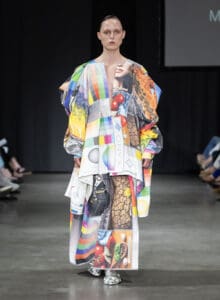
Photo Credit: Peter Håkansson
Throughout his master’s research, he explored the concept of makeshift solutions, those temporary fixes and improvised repairs people create every day. Rather than viewing these solutions as inferior to traditional design, he became interested in what they reveal about creativity, resourcefulness, and sustainability.
During our conversation, he shared one example that inspired his thinking:“My mum bumps her car consistently into all sorts of things and, well, temporarily she duct tapes the bumper. She duct tapes the door temporarily. It’s a temporal solution to the dilemma. Yet, to me, it seems like it’s always there. Like it’s always taped. And it works.” That simple observation became the foundation of his collection.
An Unexpected Discovery: Finding an Onyx Test Print in the Textile Recycling Bin
While searching through discarded materials in his university’s textile recycling room, Miłosz came across something unexpected: a large-format print sample that had originally been used to demonstrate printer performance and output quality. What immediately captured his attention was its visual complexity.“It’s such a vibrant, there’s so much going on, it’s so eclectic, it’s a work of art really,” he said. “The portraits, the interiors, the fruits, the white space, the technical graphics… the assemblage of these different things. I just found it so striking.”
Beyond its visual appeal, the print aligned perfectly with his research into makeshift design. “It’s a replacement. It’s something that comes before the actual piece you’re printing… yet it’s so striking,” he explained. “Why would I make any graphic when there’s this tool that was never intended to be a final outcome?”
A Tool Becomes the Final Product: Turning a Digital Print Test into Wearable Art
The irony of the project wasn’t lost on him. The sample existed as a means to an end, a temporary step in the digital textile printing process. Yet that temporary artifact became the finished material for a fashion piece that would later be showcased on the runway as part of Miłosz’s graduate collection.
As described in his project report: “The usage of a test print as a final surface offers a provisional solution. The design of the print is a means to an end but here is celebrated as is.”
Even the garment’s shape emerged from improvisation. Initial experiments involved an umbrella structure, which gradually evolved into an effortless draped silhouette composed of a long-sleeved top and pleated skirt.“I just want something that looks thrown on, effortless in a way,” he explained. “Because this is sort of how makeshift visually represents itself.”
Designing Around a Digital Textile Print
Unlike traditional fashion workflows where graphics are created to fit a garment, this project required the opposite approach: designing the garment around the print. The placement of individual elements within the file became crucial. “It was really important for me to have this picture with the woman with the hair in the back area,” he said. “Or I really wanted at least part of the portrait to be situated near the face of the person that’s wearing the thing.”
The color bars, imagery, technical elements, and open space all influenced how the garment was draped and constructed. “Working with such a busy visual thing, I had to be very strategic.” Rather than fighting against the complexity of the design, he embraced it.
Sustainability Through Everyday Thinking: Textile Upcycling and Sustainable Fashion Design

Photo Credit: Paulina Nowak
While sustainability is often discussed through large-scale systems and complex circular economies, Miłosz is interested in a more accessible perspective.“This kind of approach actually has a lot of potential in how we treat objects and how we elongate their lives,” he said. “It’s very everyday. It’s not a complicated circular brand structure. It’s someone just living every day, taping stuff together.”
His work demonstrates how discarded materials can take on entirely new meanings when viewed through a different lens. What was originally created to evaluate print quality became a statement about reuse, creativity, and the hidden potential of objects that might otherwise be overlooked.
From the Swedish School of Textiles to Copenhagen Fashion Week
The completed garment became part of Miłosz’s graduate collection at the Swedish School of Textiles in Borås, Sweden. The collection was first presented during the school’s Exit Show on June 3, 2026, before being selected to participate in Copenhagen Fashion Week 2026 as part of the school’s graduate showcase. What began as a discarded print discovered in a recycling room ultimately appeared on one of fashion’s most visible stages.
Seeing Tools Differently
Perhaps the most compelling aspect of Miłosz’s project is the way it encourages people to rethink everyday objects. When asked what he hopes people take away from the piece, his answer perfectly captured why the print resonated with him. “I really see this print of Onyx as a beautiful, beautiful tool. It’s a beautiful, practical thing. That’s sort of unexpected to be viewed like that.”
At Onyx Graphics, we create tools to help print professionals produce exceptional work. Seeing one of those tools transformed into a runway fashion piece was a reminder that creativity often appears in unexpected places. What began as a production sample became wearable art, demonstrating how innovation can emerge simply by looking at familiar materials in a new way.
About the Designer
Miłosz Jon, born in 2000 in Szczecin, Poland, is a fashion designer and graduate of the Swedish School of Textiles in Borås, Sweden.
His graduate work explored makeshift design methodologies, upcycling, and alternative approaches to fashion creation through a collection of eight wearable pieces. The garment featured in this story was presented at the Swedish School of Textiles Exit Show in Borås on June 3, 2026, and was subsequently selected to participate in Copenhagen Fashion Week 2026 as part of the school’s graduate showcase.
Photo & Video Credits
Runway Photography: Peter Håkansson
Runway Video: Erik Nørving
Backstage Photography: Paulina Nowak
